Voice AI for Nail Salons: An AI Booking Assistant Guide
Nail salons have a booking problem that's specific to how they operate - and it's one that generic booking software has never fully solved.
Unlike a hair salon where most clients book 2-4 weeks in advance for longer appointments, nail salon bookings are often last-minute, shorter in duration, and frequently involve walk-ins alongside pre-booked appointments. A manicure client might decide on a Tuesday that she wants her nails done before the weekend, call three salons, and book with whoever answers first.
That last part - whoever answers first - is where most nail salons are quietly losing significant revenue every week.
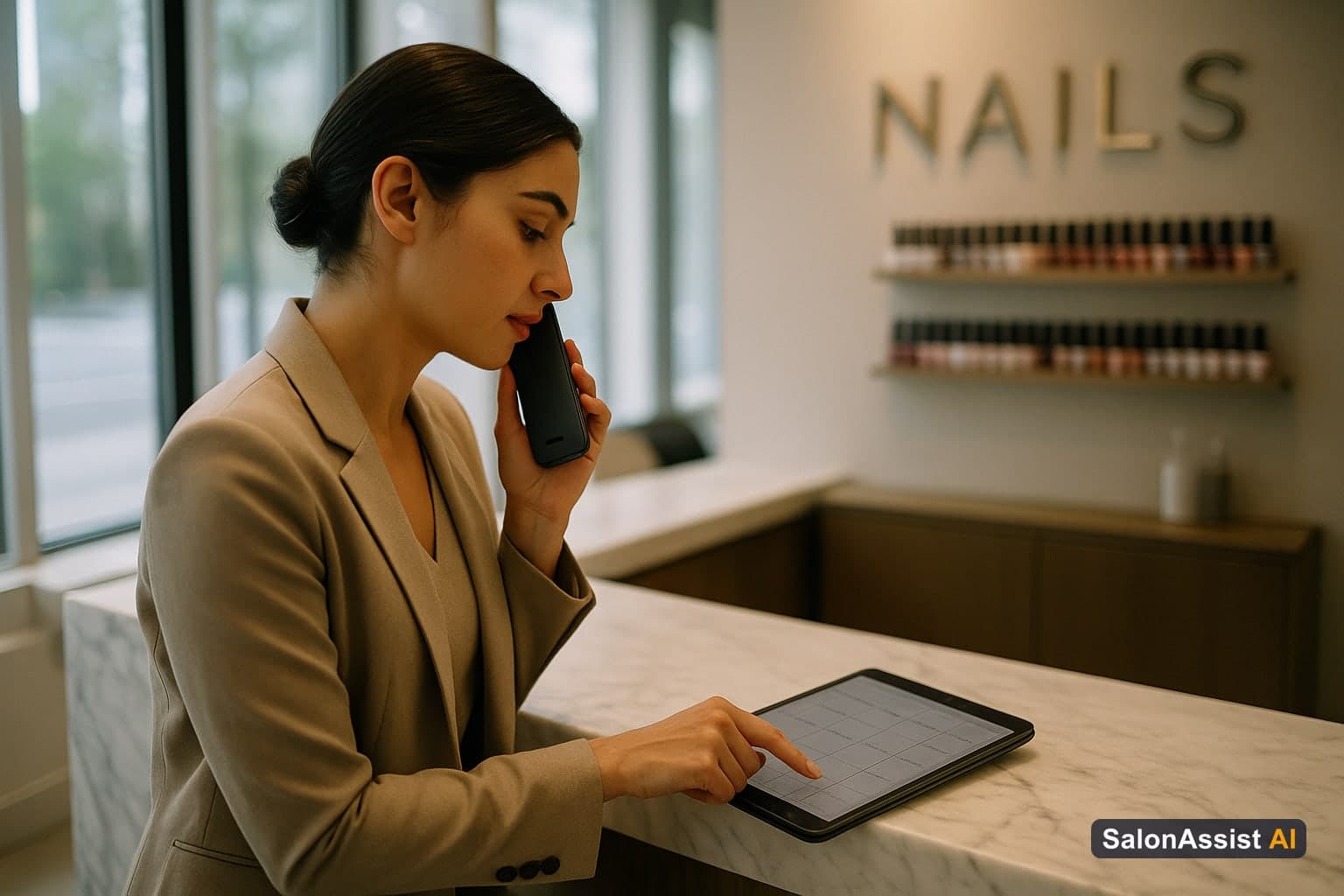
While technicians are doing a gel set, a regular calls to book her monthly pedicure. The phone rings. Nobody picks up. She tries two more salons. One answers. She books there. By the time your salon calls her back three hours later, it's too late.
Voice AI for nail salons exists specifically to solve this problem. This guide explains what it is, how it works in a nail salon context specifically, and what to look for when evaluating options.
Why Nail Salons Are Particularly Well-Suited to AI Booking Assistants
The economics of a nail salon make the case for AI booking assistance clearer than in almost any other beauty business.
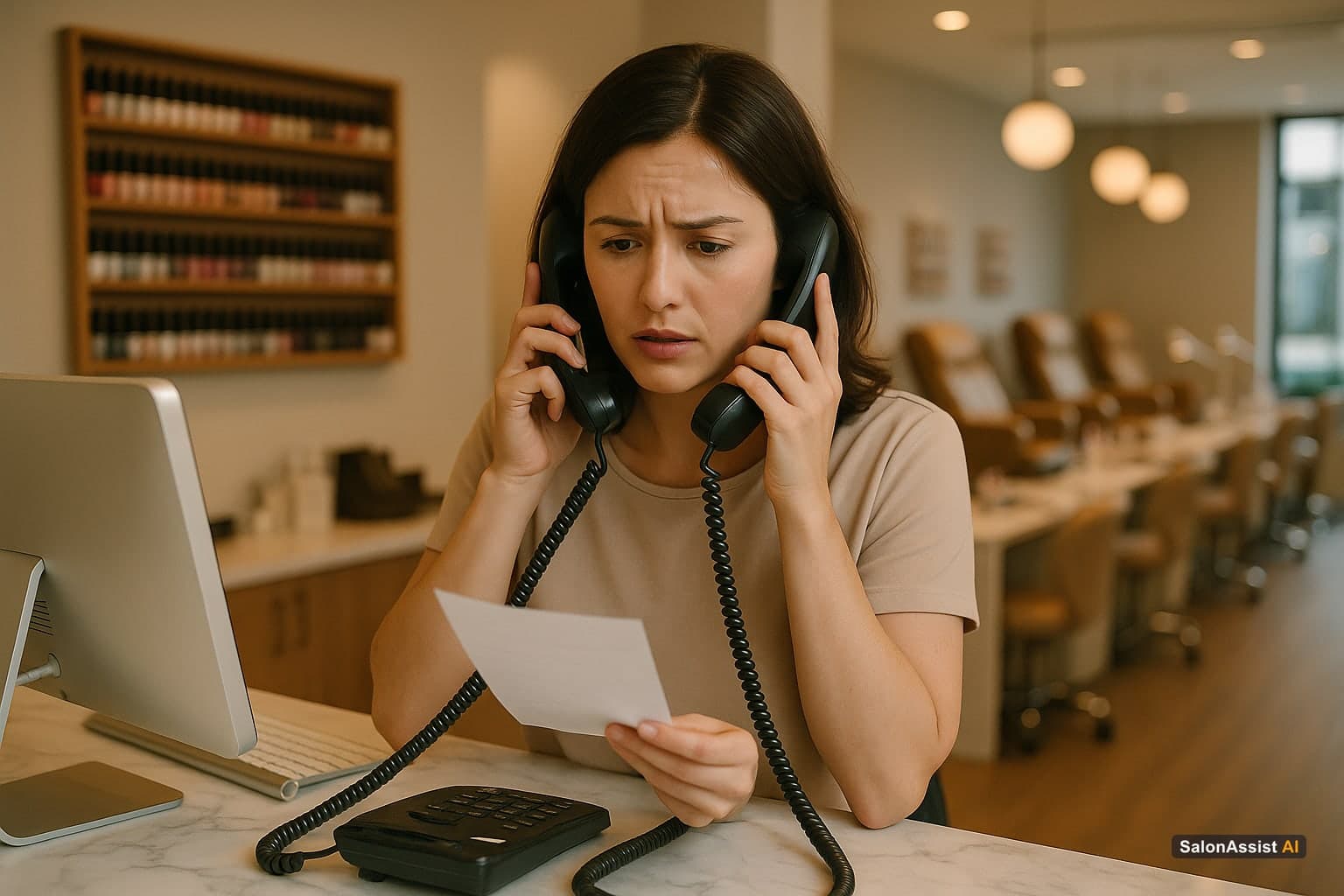
Services are shorter and higher-turnover. A classic manicure is 30-45 minutes. A gel set is 60-75 minutes. This means a busy nail salon processes more bookings per day than most hair salons - and more bookings means more incoming calls, more scheduling complexity, and more opportunities for calls to go unanswered during peak service hours.
Walk-ins are common but hard to predict. Many nail salons handle a mix of pre-booked appointments and walk-in clients, often managed through informal queue systems. An AI booking assistant that can handle inbound calls while the salon is managing a walk-in rush creates operational breathing room that a single front desk person cannot. For broader strategies on managing this specific business model, read our nail salon software guide.
Client cadence is predictable. Most nail salon clients return on a fairly regular cycle - every 2-4 weeks for gel maintenance, monthly for acrylics, occasionally for pedicures. That predictability makes it easy for your front desk or the AI receptionist to suggest the next visit while the client is already on the line, rather than relying on them to remember to call back.
Price sensitivity means a missed call often means a lost client, not just a delayed booking. A nail client who calls three salons and gets through to one will often stay with that salon simply because the booking was frictionless. Recovering a missed call the next day is rarely as effective as answering in the first place.
What a Voice AI Booking Assistant Does in a Nail Salon Context
Listen to AI Answering Salon Calls Live
Listen to how SalonAssist AI answers a live caller, checks calendar availability, and completes booking in under 90 seconds.
Voice AI for nail salons isn't a phone tree with a British accent. It's a conversational agent that understands how clients talk about nail services and responds in natural language.
Here's what that looks like in practice:
Handling service requests in plain language. A client calls and says: "Hi, I'd like to come in for a full set, maybe with some nail art - I'm thinking a French tip but I want to ask about other options too." A voice AI booking assistant trained on nail salon contexts understands this as: initial acrylic or gel full set, possible nail art add-on, consultation element. It can engage conversationally, ask clarifying questions about preferred shape and length, explain what's available, and provide an accurate time estimate before booking - rather than requiring the client to select from a rigid service menu.
Checking live availability and booking accurately. The AI checks your actual calendar in real time, knows your technicians' current availability, and can factor in service duration accurately. A full set with nail art doesn't get booked into the same 45-minute slot as a classic manicure. If the client has a preferred technician, their specific availability gets checked.
After-hours and peak-period coverage. When every technician is mid-service and the front desk is managing walk-ins, the AI answers the phone. When a client calls at 8pm to book for Saturday morning, the AI books it. When a regular calls during your lunch hour and gets through to a conversational agent rather than voicemail, she books without having to try again later.
Post-booking confirmation. After a booking, a WhatsApp confirmation can go out immediately - reducing the ambiguity that leads to no-shows, which are particularly costly in a shorter-service model where empty slots are harder to fill on short notice.
Rebooking at checkout, not automated follow-up. The most reliable way to fill a client's next visit is asking before they leave the chair or during the confirmation call - not assuming software will chase them down later. Be cautious of vendors who claim an AI will automatically message clients based on a predicted return date; SalonAssist AI's WhatsApp messages are confirmation, reschedule, cancellation, and post-visit thank-you - it does not run automated lapse-triggered marketing on its own.
The Specific Nail Services That Voice AI Needs to Understand
Generic AI booking tools struggle with nail salon service menus because the terminology is specific and the variations are significant. A voice AI for nail salons needs to understand the distinction between:
- Classic manicure vs. gel manicure vs. gel extension vs. hard gel vs. acrylic full set vs. acrylic fill
- Pedicure service types (classic, spa, gel pedicure)
- Nail art categories and their time implications (simple nail art vs. intricate design vs. 3D elements)
- Removal services and whether they're standalone or combined with a new service
- Express vs. standard vs. deluxe service tiers
Beyond the terminology, it needs to understand the typical timing for each service - because an AI that books a client for a "quick manicure" into a 30-minute slot when she actually wants a full acrylic set creates exactly the scheduling chaos that the AI was supposed to prevent.
When evaluating a voice AI booking assistant for your nail salon, ask the vendor to call the demo number and request "a gel set with removal of my old acrylics and maybe some nail art - I don't know exactly what design yet." Listen for whether the AI handles the removal + new service combination accurately, asks relevant questions about the nail art without overwhelming the caller, and produces a realistic time estimate.
The Walk-In vs. Appointment Balance: How AI Helps
One of the operational challenges unique to nail salons is managing the blend of pre-booked appointments and walk-in traffic without one group having a poor experience.

A voice AI booking assistant contributes to this balance in a specific way: it converts potential walk-in traffic into pre-bookings. When a client would have walked in on the off-chance of getting seen, but instead calls ahead and the AI offers a specific slot 30 minutes later, you've converted an uncertain walk-in into a manageable pre-booking. The client gets a confirmed time. You get better schedule visibility. The technician doesn't face the anxiety of not knowing if the afternoon is going to be empty or overwhelmed.
Over time, as a higher percentage of your daily volume becomes pre-booked through AI-assisted booking, the walk-in portion becomes more manageable - because the rest of the day is structured. You can build walk-in capacity into your schedule deliberately rather than scrambling reactively.
Nail Salon Specific: AI and the Multiple Technician Problem
In a nail salon with multiple technicians, the booking logic is more complex than it might appear. Clients often have a preferred technician. Some technicians specialize in nail art while others excel at gel extensions. Wait times are per-technician, not just per-salon.
A voice AI booking assistant that treats all technicians as interchangeable creates the same kind of mismatch that manual overbooking does: clients arrive expecting their preferred tech and find they've been assigned to whoever had the open slot.
A well-configured AI booking assistant for nail salons handles this by:
- Checking availability per technician, not just per time slot
- Defaulting to the client's preferred technician if they have one in their profile
- Offering alternatives when the preferred technician isn't available, with specific names and times rather than just "the next available slot"
- Understanding technician specializations so that complex nail art requests go to technicians who offer that service
What to Look for When Choosing Voice AI for Your Nail Salon
Nail-specific service vocabulary. The AI should understand gel, acrylic, builder gel, dip powder, French, ombre, ballerina/coffin/almond shapes, removal services, and the combinations thereof - without requiring callers to use the exact terminology the system was trained on.
Accurate duration estimation. The system needs to understand that service combinations (removal + new set + nail art) have additive time requirements, not just book the longest individual component.
Multi-technician calendar support. Separate availability checking per technician, with preference logic that checks the right person first.
Integration with your existing booking system. Bookings made through the AI should appear in your main calendar immediately - not require a sync or a manual step to confirm.
Clear escalation protocol. When a call is genuinely beyond the AI's scope - a complaint, a highly unusual service request, a client in distress - the system should take a clear message and log enough context to make the human follow-up productive, rather than guessing at an answer.
SMS/WhatsApp confirmation capability. Given the short turnaround of many nail bookings, a fast confirmation message via the client's preferred channel matters more than a formal email.
Calculate Your Salon's Missed Call Revenue Loss
SalonAssist AI's Voice AI for Nail Salons
SalonAssist AI's voice agent is trained on beauty and personal care booking contexts, including nail salon vocabulary and service logic. It asks Male or Female before listing matching services, connects to the same live calendar as your desk and website, checks multi-technician availability, and handles the booking conversation end-to-end for routine calls - freeing your front desk to focus on clients already in the chair rather than the phone. To learn more about AI reception for all salon types, review our AI receptionist for salons guide.
For nail salons specifically, the after-hours coverage and peak-period overflow capability are often where the ROI is most immediate. The calls you're currently missing during your busiest hours are the ones the AI catches first - and that's where missed revenue recovery is typically fastest.
Frequently Asked Questions (FAQ)
Related guides in this series
- 12 min read
AI Booking Assistant for Manicurists: Nail Salon Scheduling
Discover how an AI booking assistant for manicurists simplifies nail salon scheduling, reduces missed appointments, and boosts client satisfaction in 2026.
Read article - 12 min read
Nail Salon Booking System: Features and Benefits for 2026
Discover key features and benefits of a nail salon booking system in 2026. Learn how the right system boosts efficiency and client satisfaction.
Read article - 12 min read
Nail Salon Booking System: Streamline Scheduling and Client Care
Discover how a nail salon booking system can simplify scheduling, reduce missed appointments, and improve client care for your salon in 2026.
Read article - 11 min read
Nail Salon Booking System: Streamline Scheduling & Client Care
Discover how a nail salon booking system can streamline scheduling, reduce no-shows, and enhance client experience for busy nail salons.
Read article
Stop missing nail bookings
Let SalonAssist AI's voice agent answer every call, check your real-time schedule, and book the appointment while your techs are busy with clients.
Book a demo